Table of Contents
- What Restaurant Owners Should Look for in Premium Tea Suppliers
- Product Range: Loose Leaf, Sachets, and Ready-to-Drink
- Certifications, Sourcing, and Food Safety Standards
- Healthy Beverage Trends 2026: What Your Customers Want
- Loose Leaf vs. Tea Sachets: Choosing the Right Format
- The Cold Brew Tea Production Process: Why 18 Hours Matters
- Nitro Tea Wholesale for Restaurants: What to Know Before You Buy
- Profit Margin Analysis: Calculating Cost Per Serving
- Staff Training and Equipment Maintenance for Tea Programs
- Conclusion
- Frequently Asked Questions
Last Updated: September 20, 2026
What Restaurant Owners Should Look for in Premium Tea Suppliers
Finding premium tea suppliers for restaurants comes down to three things: product range, food safety documentation, and whether the supplier understands high-volume food service. This guide from 3GO - Nitro Thai Tea breaks down what actually matters when you're building a beverage program, from sourcing and certifications to cost per serving and staff training.
The beverage category is where a lot of restaurant margins quietly disappear. Operators spend hours optimizing food costs, then hand the drink menu to whoever answers the phone. That's backwards. Tea, done properly, is one of the highest-margin items you can put in front of a customer, and it requires almost no kitchen labor once the program is set up.
Below, we'll show you exactly how to evaluate premium tea suppliers, calculate real profit margins, and train staff so the product tastes the same on a Tuesday lunch shift as it does on a Saturday night.
Product Range: Loose Leaf, Sachets, and Ready-to-Drink
The format you choose determines your labor model, your equipment needs, and your cost per serving. Here is how the main format compares in practice.
Ready-to-drink options cover grab-and-go, hotel mini bars, and vending. They require no equipment and no training, and they are shelf-stable. The trade-off is less control over the final serve temperature and a higher cost per unit. Ready-to-drink works best as a speed-lane complement to a brewed program, not as a replacement for it.
The right format depends on your labor model and your menu goals, not on personal preference.
Certifications, Sourcing, and Food Safety Standards
Food safety paperwork is where casual suppliers fall apart. At minimum, look for a facility audited against FDA Food Safety Modernization Act requirements and, ideally, a GFSI-benchmarked audit such as SQF certification. Organic certification matters if you market to health-conscious customers, and it needs to be traceable to the specific lot, not just the company brochure.
Sourcing transparency separates the professionals from the pack. Ask where the leaf is grown, who processes it, and how it's shipped. A supplier who can name their estates and show you a supply chain map is one you can build a beverage program around.
Healthy Beverage Trends 2026: What Your Customers Want
Zero-sugar and clean-label drinks have moved from niche to default. Customers now read the back of the can before they read the front, and "no artificial sweeteners or preservatives" is a purchase trigger rather than a nice-to-have. This is the healthy beverage trends 2026 story in one line: people want the flavor they grew up with and none of the ingredients they've been told to avoid.
For restaurants, that shift cuts both ways. It opens up a premium price point, but it also means a syrupy, sugar-loaded tea menu looks dated next to a competitor's. A common approach is to keep one indulgent option and build the rest of the menu around clean, low-sugar products.
Loose Leaf vs. Tea Sachets: Choosing the Right Format
The right answer depends on your labor model, not your personal preference.
| Format | Best For | Trade-off |
|---|---|---|
| Loose leaf | Tea rooms, table service, signature blends | Needs brewing equipment and trained staff |
| Tea sachets | High-volume lunch service, catering | Higher cost per serving, less nuance |
| Ready-to-drink | Grab-and-go, mini bars, vending | Less control over final serve temperature |
The Cold Brew Tea Production Process: Why 18 Hours Matters
Cold brew tea is made by steeping tea leaves in cold water for an extended period, typically 18 hours, which extracts flavor without the bitterness that hot water pulls out. The cold brew tea production process is slower by design, and that's the entire point.
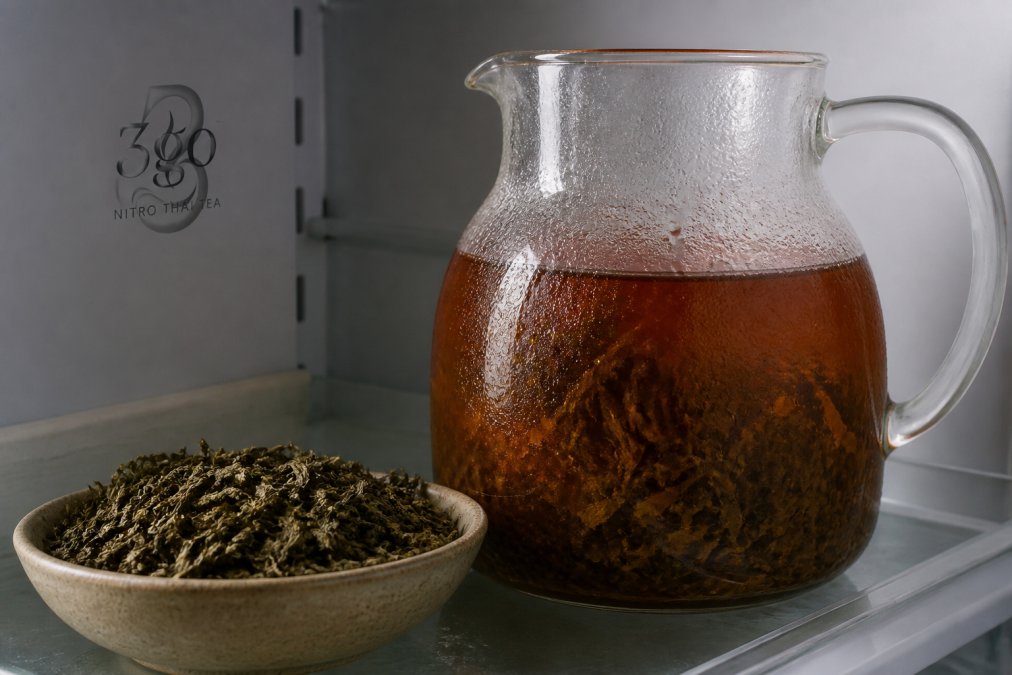
Hot brewing forces flavor out in minutes, but it also drags out tannins that leave a dry, astringent finish. Cold steeping takes its time. The result is a rounder, sweeter cup with no need for added sugar to mask the edge. That's why cold brew works so well as a base for iced tea and ready-to-drink products: the flavor is already smooth before anything else touches it.
Nitro Tea Wholesale for Restaurants: What to Know Before You Buy
Nitro tea wholesale for restaurants is a different purchase than standard tea supply, because you're buying a finished, shelf-stable product rather than an ingredient. Nitrogen infusion gives the drink a creamy mouthfeel and a velvety body without adding dairy or sugar. For operators, the appeal is simple: it tastes indulgent and the label stays clean.
3GO - Nitro Thai Tea is built on exactly that model. Every can is cold-steeped for 18 hours, infused with nitrogen for a smooth, creamy finish, and shipped shelf-stable with zero grams of sugar and no artificial additives. There's one product in the range right now, which is deliberate: one thing, done properly, rather than a sprawling catalog nobody can execute.
Minimum Order Quantities and Shipping Logistics
MOQ is where small operators get squeezed. Most wholesale distributors set a minimum order quantity that makes sense for a chain and punishes a single-location restaurant. Before you commit, confirm the MOQ, the shelf life at delivery, and whether nationwide shipping is included or billed separately.
- Confirm MOQ in cases, not units, and ask what happens on a partial reorder
- Check the delivered shelf life, not the shelf life from production date
- Ask whether the product ships ambient or requires temperature control
- Get the reorder lead time in writing
Profit Margin Analysis: Calculating Cost Per Serving
Cost per serving is the number that decides whether a tea program is worth running, and most operators never calculate it. The formula is straightforward: divide your landed cost per unit by the number of servings you get from it, then compare that to your menu price. But the formula alone is not enough. You need to know what a healthy margin looks like and how to hit it.
Start with your landed cost per unit. That is your invoice total including freight, divided by the number of units in the case. If you buy a case of 24 ready-to-drink cans for $48 landed, your cost per unit is $2.00. If you sell that can for $6.00, your gross margin per unit is $4.00, or 67%. That is a strong margin for a beverage item with no kitchen labor and no spoilage.
The gap most operators miss is not the formula. It is the volume assumption. Run your margin math across a realistic week, not a best-case day. If you sell 40 units a day at a healthy margin, the category contributes more than most appetizers, with no kitchen labor and no spoilage. If you sell 10 units a day, the same margin percentage produces a much smaller contribution. The number that matters is gross profit dollars per week, not margin percentage alone.
A common pattern is to price tea as a courtesy item rather than a profit center. That is backwards. Tea has no kitchen labor, no spoilage if you use shelf-stable formats, and no equipment cost if you choose ready-to-drink. The margin is there if you calculate it and price accordingly.
Staff Training and Equipment Maintenance for Tea Programs
Equipment maintenance is the other half. Brewers, urns, and dispensing lines accumulate mineral scale, and scale changes flavor. Descale on a fixed schedule, rinse dispensing lines daily, and replace gaskets before they fail rather than after. A neglected brewer will make good tea taste mediocre, and staff will blame the product.
Conclusion
The hard part of a tea program isn't finding a supplier. It's building the margin math that keeps the product tasting right after the first week. Most operators skip that work and then wonder why the category underperforms.
3GO - Nitro Thai Tea was built for exactly this gap. One product, cold-steeped for 18 hours, nitrogen-infused for a creamy finish, shelf-stable, zero sugar, and free of artificial additives. It's ready to serve the moment it arrives, which means no brewing equipment, no staff training curve, and no spoilage.
Order Today.
Frequently Asked Questions
What should restaurant owners look for in a premium tea supplier?
Look for suppliers who provide clear documentation on sourcing and food safety standards like SQF certification. Ask about minimum order quantities, shipping logistics for hospitality, and whether the product is shelf-stable. Request samples to evaluate flavor and how the tea performs in cold applications.
How does the cold brew tea production process impact flavor and profitability?
Cold brew tea production uses a slow, cold-steeped method that extracts flavor without bitterness, producing a smoother, cleaner taste than hot brewing. An 18-hour cold-steeped process builds a velvety body that works well over ice. Consistent flavor also lowers the risk of customer complaints and returns.
What are the benefits of offering cold-brewed tea in restaurants?
Cold-brewed tea gives restaurants a premium iced tea option that stands out from standard fountain or bottled products. It supports healthy beverage trends 2026, where customers seek zero-sugar, clean-label drinks.
How can shelf-stable, zero-sugar beverages improve restaurant inventory management?
Shelf-stable zero-sugar beverages reduce spoilage risk because they do not require immediate refrigeration before opening. That flexibility lets restaurants store product in dry stockrooms, then chill only what they need for service. Zero-sugar formulations also avoid sticky spills and syrup buildup in equipment. For hospitality operations with limited cooler space, shelf-stable options improve inventory turns and reduce the frequency of emergency reorders.